Microservices Architecture: When to Use & How to Succeed
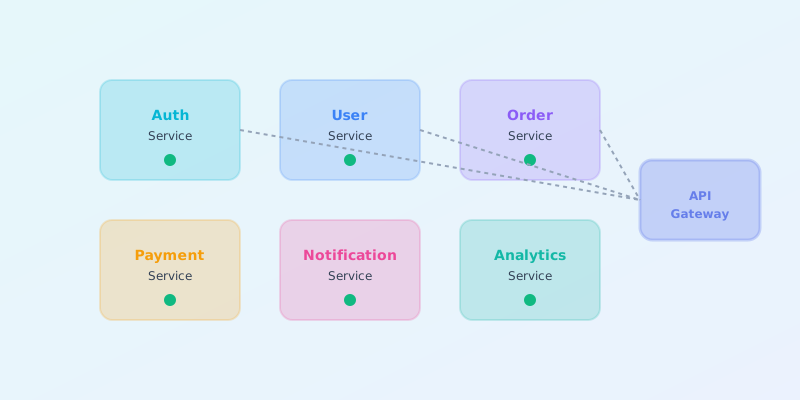
Table of Contents
Introduction
Microservices architecture has transformed how modern software systems are built and scaled. Companies like Netflix, Amazon, and Uber credit microservices with enabling rapid innovation and massive scale. But microservices aren't a silver bullet—they introduce complexity that can cripple teams unprepared for the challenges.
This guide helps you decide when microservices make sense, understand essential patterns, and avoid common pitfalls that derail distributed systems projects.
What Are Microservices?
Microservices architecture structures an application as a collection of loosely coupled, independently deployable services. Each service:
- Owns a specific business capability (e.g., user management, payment processing)
- Has its own database (database-per-service pattern)
- Can be deployed independently without affecting other services
- Communicates via well-defined APIs (typically HTTP/REST or messaging)
- Can be built with different technologies (polyglot architecture)
This contrasts with monolithic architecture where all functionality lives in a single codebase and deployment unit.
When to Use Microservices
Microservices make sense when you have:
✅ Large, Growing Teams
Multiple teams need to work independently without constant coordination. Conway's Law suggests your architecture will mirror your organization structure.
✅ Different Scaling Needs
Some parts of your system need 10x more resources than others. Microservices let you scale only what needs scaling.
✅ Varied Technology Requirements
Different problems benefit from different tools—real-time processing in Go, ML pipelines in Python, web APIs in Node.js.
✅ High Deployment Frequency
You need to deploy multiple times per day without coordinating releases across teams.
✅ Isolation Requirements
Failure in one subsystem must not bring down the entire application (fault isolation).
When NOT to Use Microservices
Avoid microservices if:
- You're just starting: Premature distribution creates unnecessary complexity. Start with a well-structured monolith.
- Team size < 20 engineers: The overhead of distributed systems outweighs the benefits.
- Unclear domain boundaries: If you can't clearly separate business capabilities, you'll create a distributed monolith.
- Limited DevOps maturity: Microservices require strong CI/CD, monitoring, and operational expertise.
- Tight coupling between features: If everything depends on everything else, distribution adds latency without benefits.
Core Microservices Patterns
Essential patterns for successful microservices architecture:
1. API Gateway Pattern
Single entry point for clients that routes requests to appropriate microservices. Handles authentication, rate limiting, and request aggregation.
2. Service Discovery
Services register themselves and discover other services dynamically. Tools: Consul, Eureka, Kubernetes DNS.
3. Circuit Breaker
Prevent cascade failures by detecting when a service is down and failing fast instead of waiting for timeouts.
4. Saga Pattern
Manage distributed transactions across services using choreography or orchestration.
5. CQRS (Command Query Responsibility Segregation)
Separate read and write operations for better performance and scalability.
6. Event Sourcing
Store state changes as a sequence of events instead of current state snapshots.
Service Communication
Two primary communication patterns:
Synchronous (Request/Response)
REST, gRPC, GraphQL
Pros: Simple, familiar, immediate feedback
Cons: Tight coupling, cascade failures, higher latency
Asynchronous (Event-Driven)
Message queues (RabbitMQ, Kafka, SQS)
Pros: Loose coupling, fault tolerance, better scalability
Cons: Complexity, eventual consistency, harder debugging
Data Management Strategies
The hardest part of microservices is managing data consistency across services:
- Database per Service: Each service owns its database schema and data
- Shared Database Anti-Pattern: Never share databases between services—it creates tight coupling
- Event-Driven Data Synchronization: Services publish events when data changes; other services subscribe
- API Composition: Aggregate data from multiple services at the API Gateway level
- CQRS: Maintain separate read models optimized for queries
Deployment & Orchestration
Modern microservices rely on containerization and orchestration:
Containerization (Docker)
Package each service with its dependencies for consistent deployment across environments.
Orchestration (Kubernetes)
Automate deployment, scaling, and management of containerized services. Handles service discovery, load balancing, and self-healing.
CI/CD Pipelines
Automated testing and deployment for each service. Independent pipelines enable true autonomous teams.
Infrastructure as Code
Terraform, CloudFormation, or Pulumi to version control your infrastructure.
Common Challenges & Solutions
| Challenge | Solution |
|---|---|
| Distributed debugging | Centralized logging (ELK, Splunk), distributed tracing (Jaeger, Zipkin) |
| Data consistency | Saga pattern, event sourcing, eventual consistency acceptance |
| Service sprawl | Clear ownership, service catalogs, consolidate when appropriate |
| Network latency | Async communication, caching, smart service boundaries |
| Testing complexity | Contract testing (Pact), component testing, service virtualization |
| Operational overhead | Kubernetes, service mesh (Istio), automated monitoring |
Conclusion
Microservices are a powerful architectural pattern, but they're not free:
- Start with a monolith and extract services only when you have clear evidence of need
- Ensure organizational readiness: autonomous teams, DevOps culture, strong operational practices
- Invest in observability: distributed tracing, centralized logging, comprehensive metrics
- Define clear service boundaries based on business capabilities, not technical layers
- Embrace eventual consistency and design for failure from day one
The companies that succeed with microservices treat them as an organizational optimization, not a technical one. If you can't articulate the specific organizational problem microservices will solve, you're not ready for them.
Need Help With Microservices Architecture?
Our Reliability Engineering service helps teams design observable, resilient distributed systems — with SLOs, distributed tracing, and incident response practices built in from the start.
Talk to Our Engineering Team