Modern CI/CD Pipelines: Automating Your Software Delivery
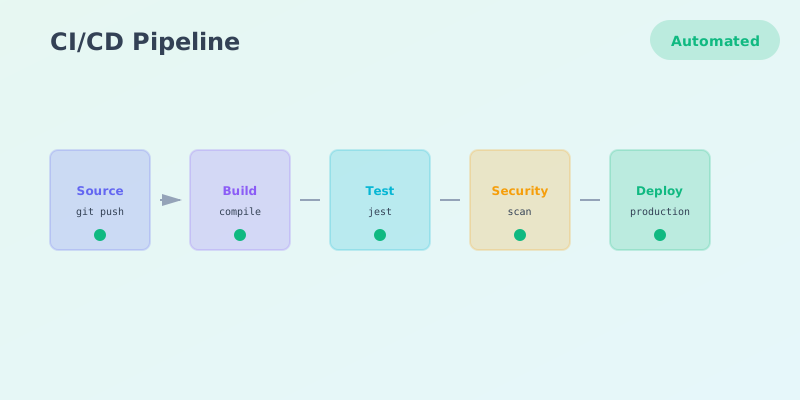
Table of Contents
Introduction
Continuous Integration and Continuous Delivery (CI/CD) has become the backbone of modern software development. Organizations with mature CI/CD practices deploy code 200x more frequently, recover from incidents 24x faster, and have 3x lower change failure rates according to the 2023 DORA State of DevOps Report.
This guide covers building production-ready CI/CD pipelines that enable fast, reliable, and safe software delivery at scale.
CI/CD Fundamentals
Understanding the core concepts:
Continuous Integration (CI)
Developers integrate code into a shared repository multiple times per day. Each integration triggers automated builds and tests to detect problems early.
- Frequent code commits (at least daily)
- Automated build on every commit
- Fast-running automated test suite
- Immediate feedback on build status
Continuous Delivery (CD)
Every code change that passes automated tests is automatically prepared for release to production. Manual approval gate before production deployment.
Continuous Deployment
Takes CD one step further—every change that passes all stages automatically deploys to production without human intervention.
Pipeline Stages
A robust CI/CD pipeline typically includes these stages:
1. Source Control Trigger
   ↓
2. Build & Compile
   ↓
3. Unit Tests
   ↓
4. Static Analysis (Linting, Security Scanning)
   ↓
5. Integration Tests
   ↓
6. Build Artifacts (Docker images, binaries)
   ↓
7. Deploy to Staging
   ↓
8. E2E Tests & Performance Tests
   ↓
9. Manual Approval Gate (CD) or Automatic (Continuous Deployment)
   ↓
10. Production Deployment
   ↓
11. Smoke Tests & Health Checks
   ↓
12. Monitoring & Alerting
Automated Testing Strategy
The testing pyramid guides your test distribution:
        ┌───────────┐
        │    E2E    │  ← Few, slow, expensive
        ├───────────┤
        │Integration│  ← Moderate number
        ├───────────┤
        │   Unit    │  ← Many, fast, cheap
└───────────┘- Unit Tests (70%): Fast, isolated tests of individual functions/components. Run on every commit.
- Integration Tests (20%): Test interactions between components, databases, external APIs.
- E2E Tests (10%): Critical user flows through the entire system. Run before production deployment.
| Test Type | When to Run | Target Duration |
|---|---|---|
| Unit | Every commit | < 2 minutes |
| Integration | Every commit | < 5 minutes |
| E2E | Pre-staging/production | < 15 minutes |
| Performance | Nightly/pre-release | Variable |
Deployment Strategies
Choose the right deployment strategy for your risk tolerance:
1. Blue-Green Deployment
Maintain two identical production environments. Deploy to inactive environment, test, then switch traffic instantly.
✅ Instant rollback
✅ Zero downtime
❌ Requires 2x infrastructure
2. Canary Deployment
Route small percentage of traffic to new version. Gradually increase if metrics look good.
✅ Low risk, gradual rollout
✅ Real production validation
❌ Requires feature flags & traffic management
3. Rolling Deployment
Update instances one at a time or in small batches. Common in Kubernetes environments.
✅ Resource efficient
❌ Slower rollback
❌ Mixed versions during rollout
4. Feature Flags
Deploy code to production but keep features disabled until ready to release.
✅ Decouple deployment from release
✅ A/B testing, gradual rollout
❌ Code complexity, flag management overhead
Infrastructure as Code
Manage infrastructure through version-controlled code:
- Terraform: Multi-cloud infrastructure provisioning
- CloudFormation: AWS-native infrastructure management
- Pulumi: Infrastructure as code using familiar programming languages
- Ansible: Configuration management and automation
- Kubernetes Manifests: Declarative container orchestration
# Example Terraform snippet
resource "aws_instance" "web" {
  ami           = var.ami_id
  instance_type = "t3.medium"

  tags = {
    Name = "web-server-${var.environment}"
  }
}

# Apply changes with audit trail
terraform plan
terraform apply
Benefits of Infrastructure as Code:
- Version control for infrastructure changes
- Reproducible environments (dev, staging, production)
- Disaster recovery through code rebuild
- Code review for infrastructure changes
- Automated testing of infrastructure
Security in CI/CD
Security must be integrated throughout the pipeline (DevSecOps):
- Secret Management: Use HashiCorp Vault, AWS Secrets Manager, or Azure Key Vault. Never commit secrets to version control.
- Dependency Scanning: Snyk, Dependabot, or GitHub Advanced Security to detect vulnerable dependencies.
- Static Application Security Testing (SAST): SonarQube, Checkmarx to find security flaws in code.
- Container Scanning: Trivy, Clair to scan Docker images for vulnerabilities.
- Dynamic Application Security Testing (DAST): OWASP ZAP for runtime vulnerability testing.
- Compliance as Code: Open Policy Agent (OPA) to enforce security policies.
Monitoring & Observability
CI/CD doesn't end at deployment. Monitor what you deploy:
Metrics
Track deployment frequency, lead time, MTTR (Mean Time To Recovery), change failure rate. Use Prometheus, CloudWatch, Datadog.
Logging
Centralized logging with ELK Stack (Elasticsearch, Logstash, Kibana), Splunk, or CloudWatch Logs. Structured logging for easier parsing.
Tracing
Distributed tracing for microservices with Jaeger, Zipkin, or AWS X-Ray. Understand request flows across services.
Alerting
PagerDuty, Opsgenie for on-call rotations. Alert on actionable issues, not noise. Define SLOs (Service Level Objectives) and SLIs (Service Level Indicators).
Key deployment metrics to track:
- Deployment Frequency: How often you deploy to production
- Lead Time for Changes: Time from commit to production
- Change Failure Rate: % of deployments causing production incidents
- Mean Time to Recovery (MTTR): How quickly you recover from failures
Best Practices
Proven practices for production-ready CI/CD:
- Keep pipelines fast: Developers won't wait 30 minutes for feedback. Optimize for <10 minute cycles.
- Fail fast: Run fastest tests first. Stop pipeline on first failure.
- Reproducible builds: Same code + same environment = same artifact every time
- Immutable artifacts: Build once, deploy many times (dev → staging → prod)
- Database migrations: Forward-compatible changes. Never break rollback capability.
- Rollback plan: Every deployment needs a tested rollback strategy
- GitOps: Git as single source of truth. All changes via pull requests.
- Progressive delivery: Combine feature flags, canary, and monitoring for safe rollouts
- Observability first: Deploy instrumentation before features
Conclusion
Modern CI/CD pipelines enable elite software delivery performance:
- Deploy on-demand with confidence
- Catch issues early through comprehensive automation
- Reduce manual toil and human error
- Enable rapid innovation and experimentation
- Improve reliability through consistent, repeatable processes
Building a mature CI/CD practice takes time. Start with basic automation and iterate. Measure DORA metrics (deployment frequency, lead time, MTTR, change failure rate) to track progress. The investment in automation pays exponential dividends in velocity and reliability.
Need Help Optimising Your CI/CD Pipeline?
Our CI/CD Pipeline Optimisation service helps teams at Maxwell Software Solutions build faster, safer delivery pipelines with measurable DORA metric improvements.
Talk to Our Engineering Team