API Design Best Practices: Building RESTful APIs That Scale
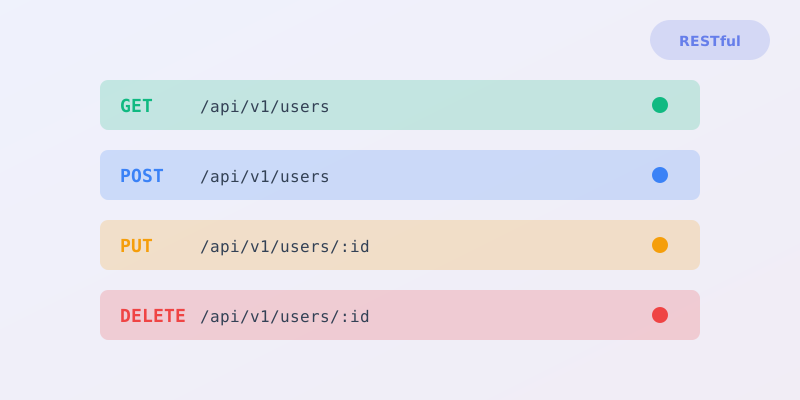
Table of Contents
Introduction
A well-designed API is the backbone of modern software systems. Whether you're building microservices, mobile apps, or third-party integrations, your API design choices impact scalability, maintainability, and developer experience.
This guide covers essential principles and best practices for designing RESTful APIs that stand the test of time.
RESTful Design Principles
REST (Representational State Transfer) is built on six architectural constraints:
- Client-Server: Separation of concerns between UI and data storage
- Stateless: Each request contains all information needed to process it
- Cacheable: Responses must define whether they can be cached
- Uniform Interface: Consistent resource identification and manipulation
- Layered System: Architecture organized in hierarchical layers
- Code-on-Demand (optional): Servers can extend client functionality
Understanding these constraints helps you make informed trade-offs when designing your API architecture.
Resource Naming Conventions
Consistent naming conventions make your API intuitive and predictable:
✅ Good Examples:
- GET /users
- GET /users/123
- POST /users
- GET /users/123/orders
- PATCH /users/123
❌ Avoid:
- GET /getUsers
- POST /user/create
- GET /users/123/getOrders
- DELETE /deleteUser/123
HTTP Methods & Status Codes
Proper use of HTTP methods and status codes creates a self-documenting API:
| Method | Purpose | Success Status |
|---|---|---|
| GET | Retrieve resource(s) | 200 OK |
| POST | Create new resource | 201 Created |
| PUT | Replace entire resource | 200 OK / 204 No Content |
| PATCH | Partial update | 200 OK |
| DELETE | Remove resource | 204 No Content |
Common error status codes:
- 400 Bad Request: Client sent invalid data
- 401 Unauthorized: Authentication required
- 403 Forbidden: Authenticated but not authorized
- 404 Not Found: Resource doesn't exist
- 409 Conflict: Request conflicts with current state
- 422 Unprocessable Entity: Validation failed
- 429 Too Many Requests: Rate limit exceeded
- 500 Internal Server Error: Server-side error
API Versioning Strategies
Planning for change is essential. Three common versioning approaches:
1. URL Path Versioning
https://api.example.com/v1/users✅ Most explicit and discoverable
❌ Can lead to URL proliferation
2. Header Versioning
Accept: application/vnd.example.v1+json✅ Clean URLs, follows HTTP standards
❌ Less visible, harder to test manually
3. Query Parameter Versioning
https://api.example.com/users?version=1✅ Simple to implement
❌ Can be overridden or ignored
Documentation Standards
Comprehensive documentation is non-negotiable for API adoption:
- OpenAPI/Swagger: Industry-standard specification format
- Interactive Docs: Let developers test endpoints directly (Swagger UI, Redoc)
- Code Examples: Provide samples in multiple languages
- Authentication Guide: Clear instructions for obtaining and using credentials
- Error Catalog: Document all error codes with explanations
- Rate Limits: Specify limits and how to handle 429 responses
// Example error response format
{
  "error": {
    "code": "VALIDATION_ERROR",
    "message": "Invalid email format",
    "details": {
      "field": "email",
      "value": "invalid-email"
    },
    "timestamp": "2024-12-20T10:30:00Z",
    "requestId": "req_abc123"
  }
}
Security Best Practices
Security must be built into your API from day one:
- HTTPS Only: Enforce TLS 1.2+ for all endpoints
- Authentication: Use OAuth 2.0 or JWT for token-based auth
- Authorization: Implement role-based access control (RBAC)
- Rate Limiting: Prevent abuse with per-user/IP limits
- Input Validation: Validate and sanitize all input data
- CORS: Configure Cross-Origin Resource Sharing properly
- API Keys: Never expose sensitive keys in URLs or logs
- Audit Logging: Track all access attempts and changes
Performance & Scalability
Design your API to handle growth efficiently:
- Pagination: Use cursor-based or offset pagination for large datasets
- Filtering & Sorting: Allow clients to request only what they need
- Compression: Enable gzip/brotli compression for responses
- Caching: Use ETag, Last-Modified, and Cache-Control headers
- Partial Responses: Support field selection (e.g., ?fields=id,name,email)
- Batch Operations: Allow bulk creates/updates where appropriate
- Async Processing: Use webhooks or polling for long-running operations
// Pagination example
GET /users?limit=20&cursor=abc123

{
  "data": [...],
  "pagination": {
    "next_cursor": "xyz789",
    "has_more": true
  }
}
Conclusion
Building a great API requires balancing multiple concerns: developer experience, performance, security, and long-term maintainability. By following these best practices, you create APIs that are:
- Easy to understand and integrate
- Resilient to change and growth
- Secure by default
- Well-documented and discoverable
Remember: your API is a product. Invest time in design, gather feedback early, and iterate based on real usage patterns. The upfront investment in thoughtful API design pays dividends in reduced support costs and faster integrations.
Want Expert API Design Guidance?
Our Code Quality Audit service includes API surface reviews — identifying inconsistencies, breaking changes, and missing standards across your services before they reach production.
Request an API Audit